ENCOUNTER FILES
MONOCHROME Roblox Monster Survival Guide
Verified appearance, warning cues, hiding mechanics, and recovery strategies for the MONOCHROME Roblox monster based on current build evidence.
Overview
Survival against the MONOCHROME Roblox monster requires recognizing auditory warnings, managing interaction risk, and utilizing environmental cover before the entity reaches your position. The official game description confirms that an unspecified presence watches players in the corridors, and current build footage demonstrates that this entity patrols the downstairs routes while you search for keys and codes. Successful navigation involves treating every hallway as a potential patrol path, prioritizing early hiding over prolonged searching, and understanding that contact triggers a reset to the upstairs area rather than a permanent failure state.
Verified Appearance and Corridor Presence
The official description for MONOCHROME states only that an unspecified presence watches players moving through the corridors. Current gameplay footage and walkthroughs consistently document this presence as a tall black figure featuring two bright eyes. This figure actively moves through the downstairs route, creating a dynamic threat that interrupts key collection and code entry. Because the official sources do not assign a name or confirm fixed patrol routes, players should treat the figure as a roaming hazard that can appear in any unsecured hallway. The visual design relies on high contrast, making the bright eyes a reliable identification marker in the game’s dimly lit environments. Players should expect the figure to traverse open spaces without predictable stopping points, requiring constant visual scanning during movement.
Warning Cues and Search-Risk Management
The reviewed build establishes clear auditory and visual warnings that signal the creature’s approach. Footsteps serve as the primary alert, accompanied by a visible approach that players can track in real time. When these cues occur, the practical response is to immediately stop searching furniture and move toward the nearest cover. Remaining engaged with drawers, tables, or lockers during an approach creates a poor escape position, as the interaction locks movement and leaves the player exposed. Long straight corridors compound this risk by providing clear lines of sight and limiting immediate hiding options. One pre-release reviewer reports that sprinting down these open halls often places players directly in the creature’s path before cover becomes available.
**Search Loop and Environmental Navigation**
The core objective requires collecting coal and four keys while entering a four-digit code. Current build observations show players starting with a flashlight, which remains active during exploration. The code 9997 appears in one documented route, and key locations require systematic checking of drawers and tables. Stamina management directly impacts search efficiency, as one current-build observation notes that players must wait for stamina to regenerate before attempting rapid repositioning. Committing to a long run without recovered stamina frequently results in forced stops directly in the creature’s patrol zone. The safest search rhythm involves checking one interactive object at a time, verifying the surrounding area, and maintaining awareness of corridor geometry before committing to a new wing. Players should avoid entering dark hallways without confirming nearby cover locations first.
Hiding Mechanics and Cover Positioning
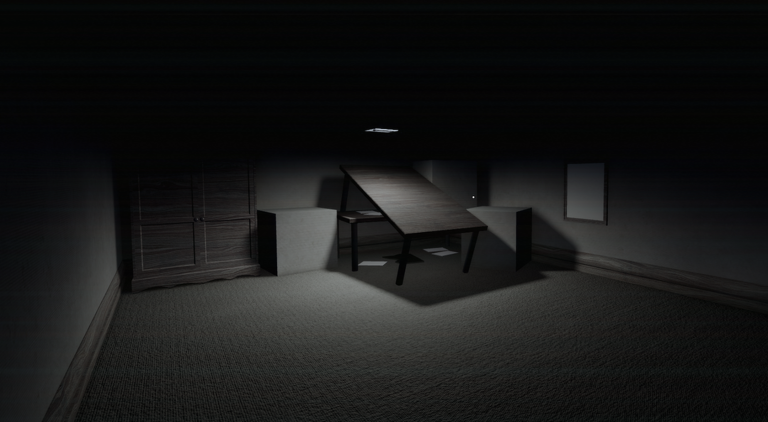
Wardrobes and closets function as the primary interactive cover in the current build. These objects provide a specific interaction that conceals the player from the creature’s corridor route. Entering cover before the entity reaches your current room proves more reliable than attempting to hide at the last moment. The reviewed guides consistently recommend initiating the hide interaction early, as the creature does not instantly bypass occupied rooms. After the immediate footsteps fade, players should remain inside the wardrobe or closet for several seconds. Multiple walkthroughs note that the creature can pause near cover, meaning premature exit often results in immediate re-engagement. Learning the location of nearby wardrobes before opening new furniture establishes a predictable safety net and reduces panic-driven movement when audio cues trigger. Spatial awareness remains critical, as players must track which rooms contain usable cover and avoid entering dead-end spaces without hiding options.
Contact Outcome and Recovery Procedures
When the creature makes contact, the game triggers a jumpscare sequence that returns the player to the upstairs area. This reset functions as a recovery checkpoint rather than a complete progress loss. One current-build walkthrough reports that previously inserted keys remain installed after a reset, though this persistence should be treated as a dated observation subject to change during early development. The official sources do not confirm a fixed life counter or permanent penalty system, and early testing footage shows players resuming their search immediately after respawning upstairs. The practical recovery strategy involves reorienting to the elevator lobby, recalling the last known safe route, and resuming the search loop with the same caution applied before the encounter. Players should avoid rushing back into the same corridor immediately after respawning, as the entity may still occupy the nearby route.
Unsupported Assumptions and Early Development Context
The official Roblox description and current build evidence do not provide the creature’s exact detection radius, movement speed, or underlying sensing model. Community nicknames and artificial-intelligence theories circulate in player discussions, but these labels are not official creature identities and should not be treated as confirmed mechanics. The game remains in early development, meaning chase behavior, closet interaction timing, life tracking, and respawn logic may shift in future updates. Players should rely on observable cues—footsteps, visible approach, and cover interactions—rather than assumed AI patterns or fixed patrol timers. Treating the entity as a variable threat that responds to player positioning and audio awareness provides the most consistent survival framework across build updates. Relying on unverified community terminology or expecting fixed detection boundaries will lead to inconsistent results as the developers refine the encounter design.
Keep the page honest
Use the version scope, source status, and verification date above when you quote this guide. If the game UI or source changes, update the claim before expanding the recommendation.
Sources to check